Written by
Sherina from Prismatic
Published on
August 26, 2026
Announcements
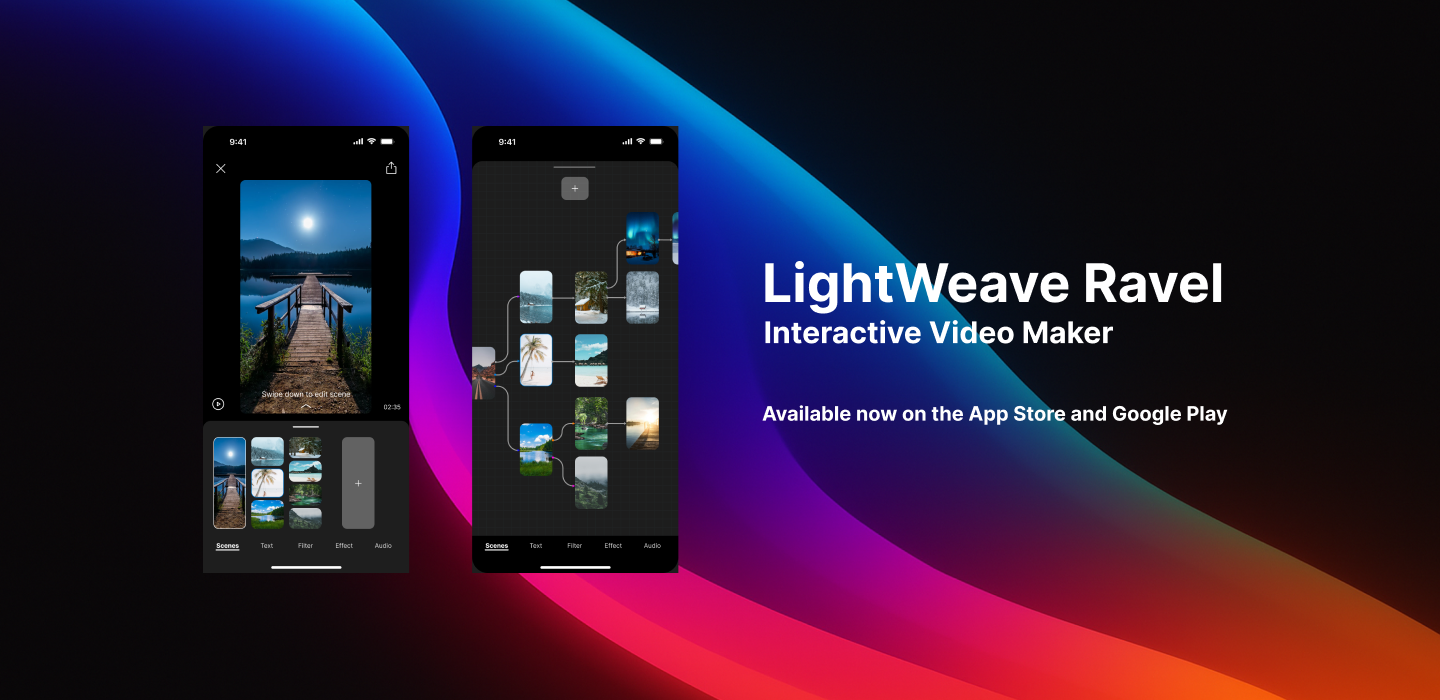
LightWeave Ravel is now available on the App Store and Google Play
Ravel is an interactive video maker available for iPhone and iPad and Google Play. As we launch our first public version, we’d like to talk about why we created Ravel, why you should try it, and share some ideas to help you start creating with it.
If you’ve tried Ravel and would like to share your thoughts with us, positive or negative, you’re welcome to join our Discord community and chat with us! Otherwise, you can get in touch via support@lightweaveravel.com. We want to make a product that you want to use, and we’d love to hear from you!
The why behind Ravel
Ravel is an interactive video maker that lets you make videos where your viewers get to decide what happens next. This includes dynamic stories, product explainers, adaptive educational videos, and quizzes, among other things. Branching media allows your viewers to actively engage with your content instead of just scrolling mindlessly.
As we launch our first public version, it’s important for us to answer a simple question: why are we building Ravel in the first place?
We at The Prismatic Company are a collection of developers, designers, and content creators, with backgrounds in designing content systems and content creation tools, specifically video and motion graphics editors for phones and tablets. Through this experience, we noticed that there was no real sophisticated option for creating interactive content on mobile, and so we started exploring.
We discovered that interactive content has a number of advantages over traditional, static content. One of the biggest advantages is that interacting and engaging in a meaningful way with the content you consume generally improves your understanding of it. This article from Scientific American highlights the importance of Self-Testing:
In one study, undergraduates were asked to memorize word pairs, half of which were then included on a recall test. One week later, the students remembered 35 percent of the word pairs they had been tested on, compared with only 4 percent of those they had not.
In another demonstration, undergraduates were presented with Swahili-English word pairs, followed by either practice testing or review. Recall for items they had been repeatedly tested on was 80 percent, compared with only 36 percent for items they had restudied.
The results of this study can benefit all creators who are struggling to deliver valuable and impactful content in an era where short-form content thrives and attention spans are shortening. Based on our own experience, and from our conversation with others, we’ve found that continuous consumption of short-form content combined with mindless scrolling often ends up leaving us feeling exhausted. However, we believe that interactive content can encourage more intentional consumption, allowing viewers to gain value through active engagement instead.
In regards to this, our co-founder and CTO Matt said it best:
Modern content is defined by short attention spans. Social media has trained people to consume content in very short bite-sized chunks. We are quick to criticize this, but perhaps we should look at it a different way: The modern world is super busy, and with the glut of content available to us, videos that take too long explaining things we already understand (or don’t spend enough time on a topic we’re unfamiliar with) are understandably frustrating.
How do you build longer, more meaningful engagement for complex topics while delivering content in bite-sized chunks and not wasting your viewers time? By making it interactive, of course!
This is where I think Ravel really shines: You can string together snappy short-form content in a way that keeps the short form interest and engagement but retains the broader context of long form media, while adapting based on user choices so you don’t waste their time.
That’s why I think Ravel is important and why I wanted to work on it.
Our product designer, Soyoung, also shared how the idea behind Ravel came from her everyday experiences consuming content on the internet and watching movies and dramas. Interactive content enables creators to make content that is more engaging, personalized, and adaptable to different audiences and preferences.
While watching content on Instagram and YouTube, I often found myself wanting to answer personality tests, quizzes, or preference-based questions immediately, instead of leaving a comment and then checking a separate result video later. I also became curious about how other people answered those same questions.
There were also moments while watching movies or dramas when I wished the main character would make a different choice. For example, hoping the female lead would end up with a different character than the one in the original story. In those moments, I thought it would be interesting if I could choose the direction of the story myself.
All of those experiences led to one question: What if people could easily create and experience content that audiences actively participate in, instead of just consuming one-directional content?
That idea became the starting point for Ravel.
Why should people try Ravel?
Creating interactive video is relatively more accessible than before. The process from ideation, creation, and publication is still time-consuming and complex, but there are now many interactive content tools available to cater different needs and requirements. The issue is that these programs are mostly only available on computers, whereas we’re seeing an increasing amount of people creating on their phones.
With Ravel, we’re making it easier and more accessible for creators to be a part of this new and evolving landscape in the same way they’re creating other types of content.
Soyoung, our product designer, stated that “interactive video is an incredibly exciting format because it increases engagement by allowing viewers to actively participate in the content experience. However, until now, interactive content has mostly existed only in specialized industries because it has been difficult for everyday users to create. Professional tools and workflows made the process inaccessible to most creators.”
“With Ravel, creators can finally communicate and interact directly with their audiences through content in a much more accessible way. We also see future potential for Ravel to become a useful tool for marketers and creators who want to better understand audience preferences through interactive participation and branching experiences,” she shared.
Moreover, beyond the obvious use cases, our co-founder Matt encourages everyone to “[...] try it because it’s a new medium for creativity, and every new medium brings new ideas and inspiration to those who experiment with it. Build things with it because it’s fun. These are early days for Ravel, the time when you can surprise its creators with new ways of using it that they haven’t imagined yet!”
If you’re hesitating whether Ravel would be suitable for what you need, our graphics engineer and researcher, Jeff, also mentioned that while “[...] there are many other tools out there for creating interactive videos, Ravel is definitely one of the easiest and most intuitive ways to do it. I think people should try it first, and I believe they will quickly get hooked on it.”
What can I make with Ravel?
If you’re reading this, you may start to wonder: Interactive videos are awesome, I get it, but what can I make with it?
In response to that, here’s what Soyoung has to say:
Interactive content is already widely used in educational content. However, most interactive experiences today are created only by professionals using specialized tools and then delivered to users as finished content. Ordinary creators with interesting ideas typically haven’t had an easy way to make interactive videos themselves.
Ravel was designed to change that.
Unlike traditional video editing apps that arrange scenes in a single linear sequence, Ravel allows scenes to connect to multiple other scenes, creating branching story flows and interactive experiences. From the beginning, our primary focus was to make it simple for users to connect scenes and create multiple branches without needing professional-level tools or technical knowledge.
Altantur, our web developer, also mentioned that, “[...] embedding interactive [experiences] into websites would be great. [For example, something like:] our app can do this, click here to start a short demo!”
One of our software engineers, Evan, also added his thoughts on this. “I think Ravel is focused on the interactive video fundamentals, [which means it] can be used to create various [experiences] such as quiz, games, vlog, educational videos, and other things. As users become more familiar with it, I expect they can create more advanced videos.”
If you’re a creator who is highly interested in storytelling, or an educator looking for fun and effective ways to make learning materials that are engaging and interactive, we’d also highly recommend Ravel to you!
Where can I get Ravel?
Ravel is available on iPhone, iPad, and Android devices. You can download it from the following app stores, based on your device:
We’re always happy to hear from you, so if you have any thoughts or feedback you’d like to share with us, you’re welcome to join our Discord community or send us an email at support@lightweaveravel.com to chat with us. We look forward to seeing you there!
RELATED ARTICLES
POPULAR TODAY
CONTENTS
- The why behind Ravel
- Why should people try Ravel?
- What can I make with Ravel?
- Where can I get Ravel?
RELATED ARTICLES
POPULAR TODAY